50L Backpacks
Need more room? The 50L backpacks are designed for multi-day adventures, trekking and demanding outdoor trips. Carry essential gear with confidence thanks to spacious storage and ergonomic comfort.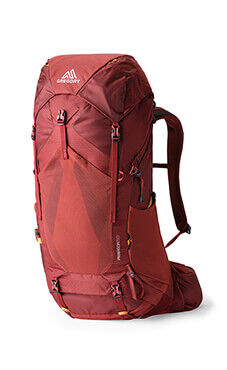


Big Enough for Proper Ambitions
Ambition is the thing that changes here. 50L backpacks are designed for multi-day adventures, trekking and demanding outdoor trips, which in practice means carrying everything you'll eat, wear and sleep in for the next few days.
What changes at this volume
Below 50 litres, you're mostly deciding what to bring. Here, you're deciding how it all goes together. Heavier loads want a frame that keeps everything stable rather than letting it sway, compression that pulls the weight in tight against your back, and a hipbelt doing the real work while your shoulders just steady things.
Several packs here carry one or more of our named technologies, which handle exactly that: how the load sits, how the pack moves with you, and how much air gets between it and your back. Each product page lists which ones that pack uses, and our backpack technologies pages go into detail.
Several different kinds of ambition
- Backpacking and multi-day packs: the mainstays. Full suspension, serious organisation and enough capacity for several days of food, clothing and sleeping kit, in men's and women's fits.
- Lightweight packs: the same carrying ability with weight taken out of the pack rather than out of your kit. For covering distance without paying for it in grams.
- Alpine packs: built for big objectives, demanding approaches, harsh climates and multi-day expeditions. For the trips where the map has contour lines stacked on top of each other.
- Travel bags with a removable daypack: 50 litres for the journey, with a 15L pack that detaches for the days you're actually there. One bag for the flight, a small one for the city.
- Youth packs: a genuine multi-day pack for a growing hiker, with adjustable torso length, an adjustable hipbelt and a youth-specific harness so it can be dialled in properly now and again in six months.
Getting the fit right
Real weight finds every flaw in a fit, so measure your torso rather than guessing: it's the length of your back that decides your size, not your height. Our guide to measuring torso length takes about five minutes.
Once you've chosen your pack, our guide to fitting a backpack walks through each adjustment in order, from hipbelt position to load lifters.
Where 50L sits in our range
- 45L: longer trips, extra equipment and changing weather.
- 50L: multi-day adventures, trekking and demanding outdoor trips.
- 55L: extended journeys and adventures needing extra equipment.
- 60L and up: long-distance hiking, trekking and expedition-style adventures.
Not sure where you land? See every size in one place with shop backpacks by litres.
FAQ
Is 50L big enough for multi-day hiking and camping?
For most multi-day trips, yes. Fifty litres is designed for multi-day adventures, trekking and demanding outdoor trips, with room for several days of food, clothing and sleeping kit without a struggle. What stretches the capacity is bulk rather than duration: heavier winter gear and bulky insulation eat space far faster than an extra day of food does. If you're heading out in summer with a reasonably compact kit, this size covers a long trip comfortably. If you're going out in colder conditions, or carrying shared equipment for two, it's worth looking at 60L and up.
What is a 50+15 travel pack?
It's a 50 litre travel bag with a 15 litre daypack that detaches, giving you 65 litres of total capacity in one purchase. The idea is straightforward: the big bag carries everything between destinations, and the small one comes off for the days you're exploring, so you're not walking around a city with a full expedition pack on your back. When you move on, it clips back into place. It suits the kind of trip where you settle somewhere for a few days and then move again, which is most travelling. If your trips are entirely on foot in the mountains, a single backpacking pack is the simpler choice: the detachable daypack only earns its place if you're putting the big bag down somewhere.
What makes an alpine pack different?
Alpine packs are built for big objectives, demanding approaches, harsh climates and multi-day expeditions, and every design decision follows from that: keeping the load close and stable on steep ground, surviving contact with rock, and carrying the kind of gear mountain routes require. Backpacking packs at the same volume are built around a different day, one measured in distance rather than difficulty, with organisation to match. Neither is the more capable pack. Choose by the ground you're covering rather than the litres, and if your route involves scrambling, climbing or serious exposure, take the alpine pack.
Do you make multi-day backpacks for children and teenagers?
We do, and they're proper packs rather than smaller adult ones. Our youth multi-day packs use a youth-specific shoulder harness and waistbelt shaped for a smaller frame, with an adjustable torso length and an adjustable hipbelt so the fit can be dialled in now and adjusted again as they grow. That adjustability matters more than the volume does. It also means the pack keeps fitting properly rather than being bought a size too big and endured for two years. Browse the full range in our youth packs.
How much weight should I carry in a 50L backpack?
Check the recommended maximum carry weight on the product page for the pack you're considering, because it varies by model and it's the figure the suspension was designed around. Beyond that, the honest answer is that most people carry more than they need to. Weight adds up in small decisions rather than big ones, and the fastest gains usually come from your heaviest three items rather than from leaving out socks. Whatever you end up with, load the pack properly before judging the fit: the top edge of the hipbelt should sit around 2.5 cm above the top ridge of your hip bones, so the weight rests on the shelf of your hips rather than sliding down.